
categories
HOT TOPICS
- The Accelerator Conundrum
- The Startup Velocity Question
- Platform as a Service
- Man and Superman
- Web 3.0 = (4C + P + VS)
- The Future: End of Capitalism
- Capitalism 2.0

The Next Big Innovation in Microprocessors: Anant Agarwal (Part 14)
Here we discuss the current market environment, the competitive landscape with a focus on what current chips are being displaced by the multicore chips.
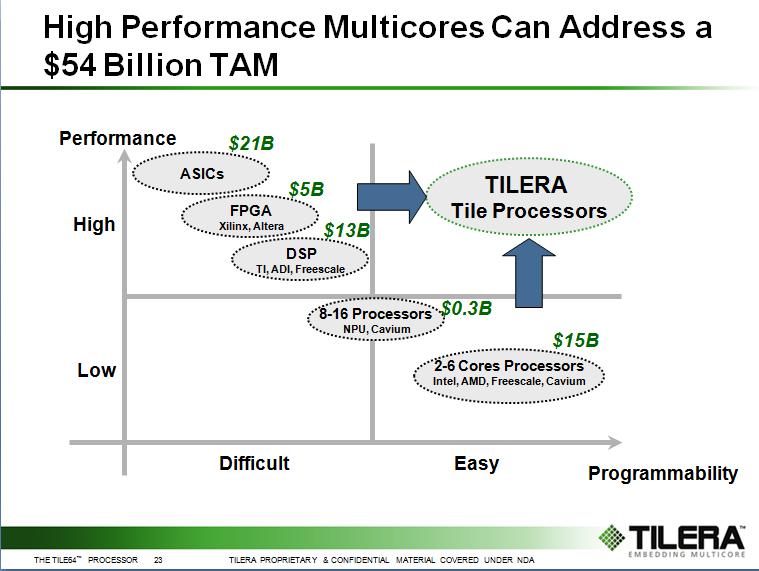
SM: I read in the slides you sent me that you are expecting a TAM (Total Available Market) of $54 billion, is this based on the two markets we discussed – Intelligent Networking and HD Video? AA: The timeline that was shown there was to indicate that you can take existing semiconductors and plunk them down on dual axis.
You then have variables for programmability, performance and power. [See slide below.]
The more you come to the bottom right corner, you get the programmability but not the performance. If you move to gain performance, then you cut out on the programmability features. DSPs fall somewhere in the middle. Depending on the customer, in some, we are displacing processors, in others, we are displacing FPGAs.
So we are seeing a wide range of needs at customer sites. We are thus offering truly embedded processor cores, that can address various market needs, starting with the Intelligent Networking and HD Video segments. But we can, over time, address the more generic microprocessor markets as well with the same technology.
SM: What is not on this chart is cost. One of the problems with ASICs is that it has become much too expensive to build one. AA: Yes, with ASIC, for example, the non-recurring costs are going through the roof. That is a big issue.
In our case, we are taking a general purpose chip, writing software for it, so in the end it is a much better solution. People care about performance, performance per watt, performance per dollar, time to market, and we have an advantage in all of these vectors. For example, in networking, if we look at the Snort application, we have 10 GIG per second for Snort, which is the first time someone has been able to do that. [Wikipedia: Snort is a free software network intrusion detection and prevention system capable of performing packet logging and real-time traffic analysis, on IP networks. Snort was written by Martin Roesch but is now owned and developed by Sourcefire, of which Roesch is the founder and current CTO. Proprietary versions with integrated hardware and support services are sold by Sourcefire.]
SM: What is your competitive scenario right now? AA: In our two markets, networking and video, we are unique. At one customer site they are using a general purpose processor, and they are able to get to 500 MBs per second, and they want to get to 10 GBs, so they are displacing the general purpose architectures and using our chip. The general purpose is an x86 or something. At another customer site they have 8 DSPs, and they want to use one of our chips.
SM: What about the multimedia market? AA: The big player there is TI. That is where the video is largely handled by DSPs. At one customer site they are using a board full of FPGAs.
SM: Can FPGA’s get to that level of performance? AA: It is very difficult, it is like building hardware. They use many FPGAs, and it is not clear they can get the performance, but the performance is better than processors. It is hard to manage, so here they are able to take our chip and write C code and get that performance. It is a real no-brainer for them. FPGAs are being displaced in some places.
[Part 13]
[Part 12]
[Part 11]
[Part 10]
[Part 9]
[Part 8]
[Part 7]
[Part 6]
[Part 5]
[Part 4]
[Part 3]
[Part 2]
[Part 1]
This segment is part 14 in the series : The Next Big Innovation in Microprocessors: Anant Agarwal
1 2 3 4 5 6 7 8 9 10 11 12 13 14 15
